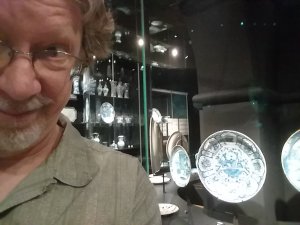
Years ago, my curiosity about the wide world of ceramics led me to a West African pottery excavation, a traditional Japanese-style apprenticeship, and a few years working and living among rural Central American potters.
These experiences impressed upon me the intimate ways in which so many potters around the world connect to the places they live. Ironically, when it came time for me to establish my own shop I found that I knew nothing about the story of pottery making in my own back yard – nor its connection to my own family tree! This realization led me to redware and delftware as a ‘return home,’ to make pottery reflective of the roots of my background and of where I live. I now find myself on a life-long path of learning and exploration.
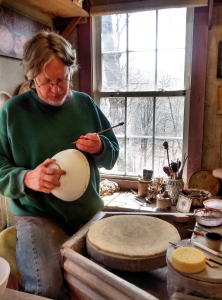 My approach to these deeply rooted pottery styles goes beyond simply ‘interpreting’ or ‘being inspired by’ history. I recognize such styles as ‘visual languages.’ To express my own creative voice through these languages requires an intimate sensitivity to, and nuanced appreciation of the complex interplay between resilience and adaptation that defines nearly all ‘traditional’ ceramic art.
I love this approach to ceramics. I love not just the forms but also the stories, the quirky sense of humor, the enigmatic imagery, the elegance. The more I study ceramic history, the more I love it. I love the places it has taken me, the people it has introduced me to along the way, and how all that has helped me to grow as a potter.
My work includes shapes and imagery that have long been part of the stylistic repertoire of redware and delftware, as well as my own contributions to these ever evolving ceramic conversations.
Steve’s Bio:
Stephen Earp earned a Ceramics BFA from the University of Iowa in 1986, followed by an apprenticeship to Richard Bresnahan at St. John’s Pottery in Minnesota. Earp worked on archeological digs in the Ivory Coast, as ceramic field technician in Nicaragua with Potters for Peace, and as Master Potter at Old Sturbridge Village in Massachusetts. He established Stephen Earp Redware in Shelburne Falls, MA. in 2004.
Earp has been listed in Early American Life’s annually awarded Directory of Traditional American Crafts since 2007, and in the Massachusetts Cultural Council’s Keepers of Tradition archive since 2010. He was recognized by the MCC’s Traditional Arts Fellowship program in 2008, 2016 and 2021. In 2020, Earp guest curated “American Clay: Modern Potters, Traditional Pots” at the Fuller Craft Museum in Brockton, MA. His work was awarded ‘Best Utilitarian‘ in the “State of Clay” Biennial Exhibition for Massachusetts Clay Artists in 2025.
Earp’s writings on ceramics include, among other outlets, the series “This Day in Pottery History,” syndicated for the on-line magazine “This Is Diversity” from 2008 to 2012 and ongoing in blog and podcast formats, and contributions to “Ceramics in America,” an annual compilation of research and commentary on historical ceramics topics.
His work can be found at museums, historical sites, and galleries nationwide.