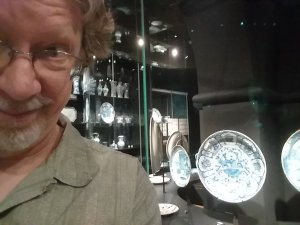
Years ago, my curiosity about the wide world of ceramics led me to a West African pottery excavation, a traditional Japanese-style apprenticeship, a year and a half long sojourn in Great Britain exploring pottery history and hands-on pottery making and there, and a few years working and living among rural Central American potters.
These experiences impressed upon me the intimate ways in which so many potters around the world connect through their pottery to the places they live. I wanted that same sensibility in my work when it came time for me to come home and establish my own pottery shop. Ironically, I quickly realized that up until then I knew nothing about the story of pottery making in my own back yard – nor its connection to my own family tree! This realization led me to redware and delftware as a ‘return home,’ to make pottery reflective of the roots of my background and of where I live. I now find myself on a life-long path of learning and exploration.
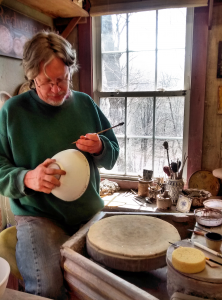 My relationship to these deeply rooted pottery styles goes beyond simply ‘interpreting’ or ‘being inspired by’ history. I recognize them as forms of ‘visual language.’ To express my own creative voice through these languages requires an intimate sensitivity to, and nuanced appreciation of the complex interplay between resilience and adaptation that defines nearly all ‘traditional’ ceramic art.
I love this approach to ceramics. I love not just the forms but also the stories, the quirky sense of humor, the enigmatic imagery, the elegance. The more I study ceramic history, the more I love it. I love the places it has taken me, the people it has introduced me to along the way, and how all that has helped me to grow as a potter.
I add my voice to conversations in clay that span centuries.
Steve’s Bio:
Stephen Earp is a ceramic artist who applies traditional redware and delftware styles to his decorative and functional earthenware. Among the various recognitions garnered for his work in ceramics and ceramic history are inclusion in the National Directory of Traditional American Crafts, the Massachusetts Cultural Council’s Keepers of Tradition Archive, and the MCC’s Traditional Arts Fellowship Program along with top awards in national and international ceramics exhibitions. He was guest curator for the exhibit “American Clay: Modern Potters, Traditional Pots” at the Fuller Craft Museum in Brockton, MA. Earp’s writings on ceramics and ceramics history include the series “This Day in Pottery History,” initially syndicated for the on-line magazine “This Is Diversity” and ongoing in blog and podcast formats, among other outlets. Current projects include a series of large thrown chargers that explore the multi-layered narrative potential of historical genre painting.